


Blog Detail

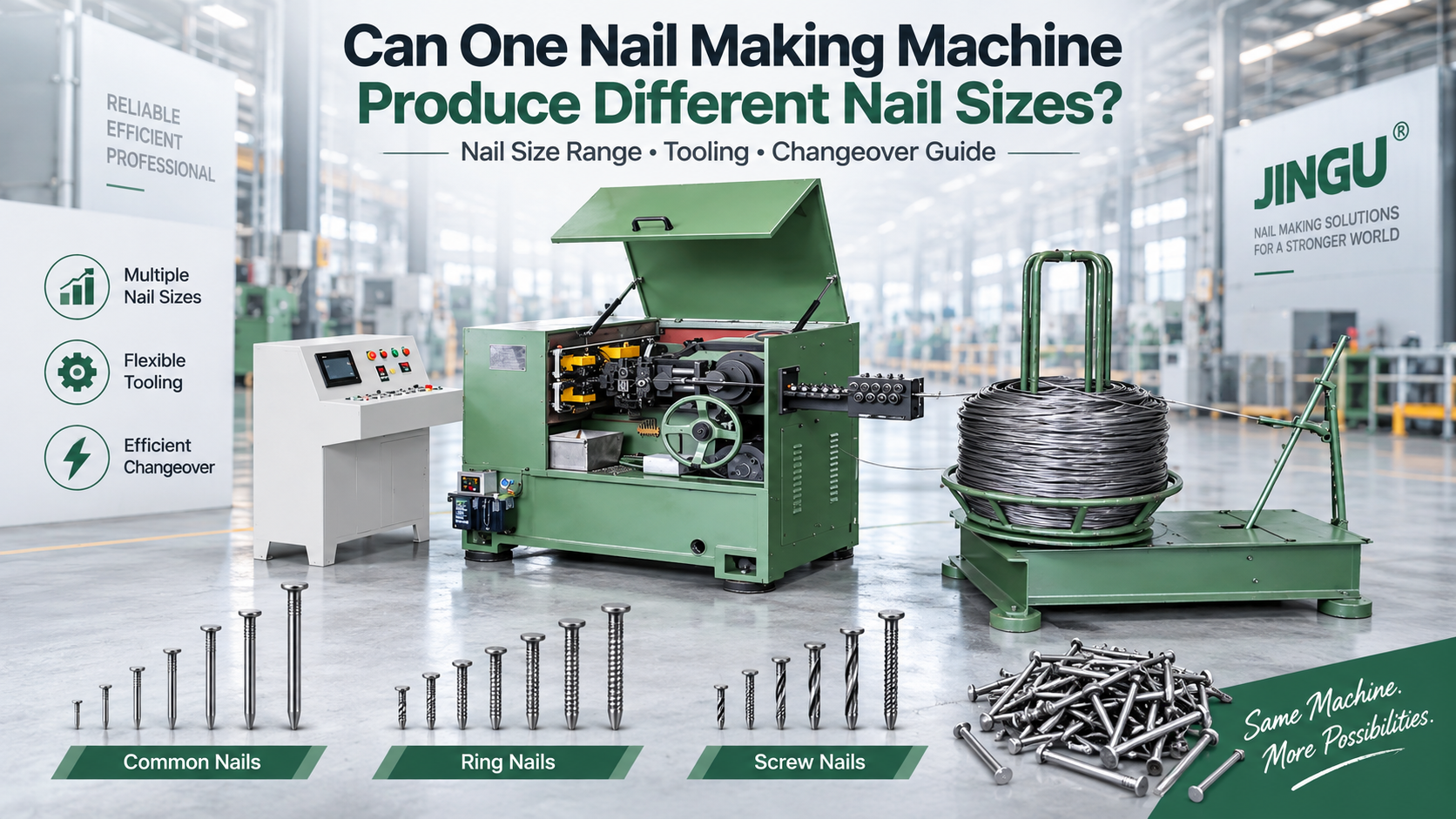
Can One Nail Making Machine Produce Different Nail Sizes? Nail Size Range, Tooling & Changeover Guide
When planning a nail factory, one of the most common questions is:
Can one nail making machine produce different nail sizes?
The short answer is yes.
One nail making machine can normally produce several nail sizes within its designed diameter and length range. However, one machine cannot efficiently cover every nail size.
The correct machine depends on:
Nail diameter
Nail length
Nail type
Steel wire diameter
Tooling
Required production capacity
Frequency of product changeovers
For this reason, a nail manufacturer should not select a machine only by maximum nail length or maximum speed.
The complete nail size list should be considered first.
Quick Answer: Can One Nail Making Machine Make Different Nail Sizes?
Yes.
If the required nail sizes fall within the machine's designed working range, the same machine can normally be adjusted to produce different specifications.
For example, changing from one nail length to another while keeping the same wire diameter is relatively simple.
Changing both nail length and wire diameter normally requires more adjustment because the feeding system, clamping components and tooling may also need to be changed or reset.
The most important question is therefore not:
Can the machine make different nail sizes?
It is:
Are my main nail sizes within the efficient production range of the same machine?
1. What Determines the Nail Size Range of a Nail Making Machine?
A nail making machine converts steel wire into nails through several synchronized processes:
Wire Straightening → Wire Feeding → Clamping → Cutting → Heading → Point Forming → Finished Nail
Every machine is designed around a certain mechanical range.
The main factors are:
Nail Diameter
A thicker nail requires more steel and greater forming force.
Producing a 2.0 mm nail is very different from producing a 5.0 mm nail.
Nail Length
Longer nails require a longer wire feeding distance and different mechanical capacity.
Wire Diameter
The incoming wire must match the required nail shank diameter and the machine's wire range.
Tooling
Cutters, punches and clamping dies must be suitable for the nail specification.
This is why one small nail machine should not be expected to produce everything from short thin nails to long heavy construction nails.
2. Nail Diameter Is as Important as Nail Length
Many first-time nail manufacturers tell us:
"I want to produce nails from 50 mm to 100 mm."
This information is not enough to select a machine.
We also need to know the nail diameter.
For example:
2.5 × 75 mm
and
4.0 × 75 mm
have the same length but very different wire diameters and nail weights.
The machine therefore should always be selected according to:
Nail Diameter + Nail Length + Target Capacity
rather than nail length alone.
3. JINGU High-Speed Nail Making Machine Size Range

JINGU offers different high-speed nail making machine models for different nail size ranges.
Model | Nail Diameter | Nail Length | Maximum Speed |
|---|---|---|---|
JG-D70 | 1.8–2.5 mm | 25–70 mm | 850 pcs/min |
JG-D90 | 1.8–3.5 mm | 40–90 mm | 800 pcs/min |
JG-D130 | <4.5 mm | 75–130 mm | 550 pcs/min |
JG-D160 | <5.5 mm | 130–160 mm | 450 pcs/min |
These are maximum machine specifications.
Actual production capacity depends on the nail size, steel wire, tooling, machine settings and operating conditions.
For complete machine specifications, see our high-speed nail making machine range.
4. JG-D70: Small and Medium Common Nails
The JG-D70 covers:
Diameter: 1.8–2.5 mm
Length: 25–70 mm
Maximum speed: 850 pcs/min
This model is suitable for factories focused mainly on smaller and medium common wire nails.
Possible specifications may include products such as:
2.0 × 40 mm
2.3 × 50 mm
2.5 × 60 mm
provided that the actual product and tooling requirements are confirmed.
The advantage of selecting a machine around your main product range is that you do not pay for unnecessary size capacity while sacrificing production efficiency.
5. JG-D90: Wider Common Nail Size Coverage
The JG-D90 high-speed nail making machine covers:
Diameter: 1.8–3.5 mm
Length: 40–90 mm
Maximum speed: 800 pcs/min
For many common nail factories, this range covers several frequently used construction, furniture and wooden packaging nail sizes.
A factory may therefore use the same machine for multiple nail specifications and arrange production in batches.
However, machine range alone should not determine the final configuration.
If several sizes all have large continuous orders, using multiple machines may be more efficient than repeatedly changing one machine.
6. JG-D130 and JG-D160 for Larger Nails
For longer and thicker nails, larger machines are required.
The JG-D130 covers nails up to approximately:
4.5 mm diameter
and
75–130 mm length
while the JG-D160 is designed for longer products up to:
5.5 mm diameter
and
130–160 mm length
These machines operate at lower pieces-per-minute speeds than smaller models, but this does not mean lower production in every situation.
Larger nails weigh much more per piece.
Therefore:
PCS/min alone should never be used to compare production capacity between different nail sizes.
For detailed calculations, see our nail making machine production capacity guide.
7. What Happens When Only Nail Length Changes?
Changing nail length while keeping the same wire diameter is normally the simplest type of product changeover.
For example:
2.5 × 50 mm
to
2.5 × 60 mm
The diameter remains 2.5 mm, so the main adjustment is related to wire feeding length and the corresponding machine setting.
On JINGU high-speed nail making machines, a typical reference time for changing only nail length while keeping the same wire diameter is approximately:
3–5 minutes
Actual changeover time depends on:
Operator experience
Nail specification
Machine condition
Production requirements
This type of change is much easier than changing wire diameter.
8. What Happens When Nail Diameter Changes?
Consider:
2.5 × 50 mm
changing to:
3.0 × 70 mm
Now both diameter and length change.
The operator may need to adjust:
Wire feeding assembly
Wire straightening
Clamping die
Cutter
Punch
Other relevant tooling
Feeding length
JINGU provides approximately 20 minutes as a typical reference when wire diameter also changes and the feeding assembly and clamping die require adjustment.
Actual time depends on the specification and operator.
This is why production planning is important.
A machine that changes diameter six times per day will lose considerably more productive time than a machine producing one specification continuously.
9. What Tooling Changes When Nail Size Changes?

The main nail making machine wear and forming components include:
Nail Cutter
The cutter separates the nail from the steel wire and helps form the nail point.
Punch
The punch forms the nail head.
Clamping Die
The clamping die holds the wire securely during nail formation.
Different nail diameters, nail heads or special product requirements may require different tooling.
Therefore, when ordering a nail making machine, it is better to send the supplier your complete nail specification list.
Do not only say:
"I need a common nail machine."
Instead provide:
Diameter × Length
for every important product.
10. Example: Can One Machine Make 2.5 × 50 mm and 3.0 × 75 mm Nails?
Yes, these two specifications fall within the dimensional range of the JG-D90.
However, this does not mean that no adjustment is required.
For:
2.5 × 50 mm
to
3.0 × 75 mm
the wire diameter changes.
The factory should therefore consider:
Appropriate steel wire
Tooling
Feeding adjustment
Clamping adjustment
Changeover time
Test production after adjustment
The important distinction is:
Machine capability does not mean zero-change production.
A flexible machine can produce different specifications, but the production process still needs to be correctly adjusted.
11. One Machine or Several Machines?
This depends on the production plan.
Situation A: Small Start-Up Factory
Suppose a new factory wants to produce:
2.0 × 40 mm
2.5 × 50 mm
3.0 × 70 mm
but demand for each size is relatively small.
Using one suitable machine and producing each specification in batches may be economical.
Situation B: High-Volume Nail Factory
Suppose the factory has continuous orders for:
2.5 × 50 mm
3.0 × 75 mm
3.5 × 90 mm
If each product requires several tons every day, repeatedly changing one machine can become inefficient.
It may be better to dedicate different machines to different product groups.
The final decision should consider:
Machine Investment
vs
Changeover Downtime
vs
Required Daily Output
12. How Frequent Size Changes Reduce Production Efficiency
Every size change may involve:
Stopping production
Changing wire
Tooling adjustment
Feeding adjustment
Test running
Nail inspection
Fine adjustment
During this time, the machine is not producing saleable nails.
For this reason, professional factories usually use batch production.
Instead of changing five specifications every day, the factory may run one specification continuously for several days before changing to the next.
This increases machine utilization.
13. Can One Machine Make 1-Inch to 6-Inch Nails?

Generally, it is not practical to expect one nail making machine to efficiently cover an extremely wide range from approximately 25 mm to 150 mm.
The difference between these products includes:
Wire diameter
Nail weight
Feeding length
Forming force
Machine structure
Tooling
A factory with a broad product range normally needs more than one machine model.
For example:
Small nails → D70
Medium common nails → D90
Longer nails → D130
Large long nails → D160
The exact configuration depends on the actual product mix.
14. Which Nail Sizes Should a New Nail Factory Produce First?
A new investor often wants to produce as many nail sizes as possible.
This is not always the best strategy.
Before buying machines, investigate the local market.
Talk to:
Hardware wholesalers
Building material distributors
Construction companies
Furniture manufacturers
Pallet manufacturers
Wooden packaging factories
Identify the most frequently purchased nail sizes.
Then design the first production line around those products.
A factory that efficiently produces five popular sizes may perform better than a factory equipped for twenty sizes with little market demand.
15. Nail Size Also Changes KG/Hour Production
Pieces per minute does not directly tell you how many kilograms of nails the machine produces.
Consider:
2.0 × 40 mm nail
and
3.5 × 90 mm nail
The second nail contains much more steel.
A useful formula is:
KG/hour = PCS/min × 60 × Nail Weight (g) ÷ 1,000
For realistic production planning, practical operating efficiency should also be considered.
This is explained in detail in our nail making machine production capacity guide.
16. Raw Material Must Match Every Nail Size
If nail diameter changes, the required wire diameter also changes.
For example:
A factory producing several nail sizes may need finished wire such as:
2.0 mm
2.5 mm
3.0 mm
3.5 mm
If the factory purchases 6.5 mm wire rod, a wire drawing machine can prepare the required wire diameters before nail production.
The typical process is:
Steel Wire Rod
↓
Wire Drawing
↓
Required Nail Wire Diameter
↓
Nail Making
↓
Polishing
↓
Packaging
For steel grade selection, see our Q195 vs Q235 Steel Wire for Nails guide.
17. How to Choose a Machine for Multiple Nail Sizes
Prepare a nail specification table before asking for a quotation.
For example:
Nail No. | Diameter | Length | Target Output |
|---|---|---|---|
1 | 2.0 mm | 40 mm | 1 ton/day |
2 | 2.5 mm | 50 mm | 3 tons/day |
3 | 3.0 mm | 70 mm | 2 tons/day |
4 | 3.5 mm | 90 mm | 1 ton/day |
This information allows the manufacturer to evaluate:
Which sizes can share one machine
Which sizes should use another model
Number of machines
Required tooling
Production capacity
Future expansion
This is more reliable than selecting machines from a catalog without considering the product mix.
18. Common Mistakes When Choosing a Multi-Size Nail Machine
Mistake 1: Choosing Only by Maximum Nail Length
Always confirm diameter as well.
Mistake 2: Choosing Only by Maximum Speed
Maximum PCS/min does not equal maximum tons/day.
Mistake 3: Assuming All Sizes Use the Same Tooling
Different diameters and product designs may require tooling changes.
Mistake 4: Ignoring Changeover Time
Frequent changes reduce actual production capacity.
Mistake 5: Buying Before Researching the Local Market
Machine configuration should follow product demand.
Mistake 6: Ignoring Raw Material Availability
A machine is not useful if suitable steel wire is unavailable locally.
19. Machine Range vs Production Economics
The machine with the widest possible size range is not automatically the best investment.
Suppose 80% of your orders are:
2.5 × 50 mm common nails
and only 5% require very long nails.
Buying all machines around the rare long-nail requirement may increase investment unnecessarily.
A better approach is:
Identify your main nail products.
Calculate required tons/day for each size.
Group similar sizes.
Select machines for those groups.
Leave reasonable capacity for future expansion.
This makes machine selection a production-planning decision rather than a catalog decision.
20. What Information Should You Send JINGU?

To recommend the correct machine, send:
1. Nail Diameter
Example: 2.5 mm
2. Nail Length
Example: 50 mm
3. Nail Type
Example: Common wire nail
4. Required Production
Example: 5 tons/day
5. Available Raw Material
Example: 6.5 mm Q235 wire rod
6. Working Hours
Example: 18 hours/day
7. Local Power Supply
Example: 380 V / 50 Hz / 3 Phase
If you have multiple nail sizes, send the complete list.
JINGU can then group the specifications and recommend a suitable machine configuration.
Frequently Asked Questions
Can one nail making machine produce different nail sizes?
Yes. A nail making machine can normally produce several nail sizes within its designed diameter and length range.
Do I need a different machine for every nail size?
No. Several specifications can often share one machine if they fall within the same machine range.
How long does it take to change nail length?
If the wire diameter remains unchanged, JINGU provides approximately 3–5 minutes as a typical reference.
How long does it take to change wire diameter?
If the wire diameter also changes, approximately 20 minutes may be required to adjust relevant feeding and clamping components under typical conditions.
Do different nail sizes require different cutters and dies?
They may. Tooling requirements depend on diameter, head type, point and other nail specifications.
Can one machine produce nails from 25 mm to 160 mm?
Normally, this wide range requires several machine models.
Does changing nail size reduce production capacity?
Yes. Machine stopping, tooling adjustment and test production reduce productive running time.
How do I know which JINGU model I need?
Send the nail diameter, nail length, target production and available steel wire. The machine can then be selected according to your actual products.
Choose the Machine According to Your Nail Market
The purpose of a flexible nail making machine is not to produce every possible nail.
The goal is to efficiently produce the nail sizes your customers actually buy.
Send JINGU your complete nail size list and target production.
We can help evaluate:
Suitable machine model
Number of machines
Nail size grouping
Tooling requirements
Production capacity
Wire drawing requirements
Choose the production system according to your market—not simply according to the highest machine speed.
Related Blogs
-
 Coil Nail Production Line: Which Machines Do You Need and How Do You Size Them?A buyer asking for a “coil nail machine” may mean a machine that forms individual nails or a machine that welds those nails into coils. These are separate production stages. Ordering a fast collator without enough correct
-
 Three Containers of Steel Strip Nail Equipment and Wire Loaded for Southeast AsiaOn 28 September 2026, JINGU Machinery loaded three containers for shipment to Southeast Asia. The dispatch included three sets of steel strip nail production equipment and 20 tonnes of steel wire. Photos from the worksh
-
 Can One Nail Making Machine Produce Different Nail Sizes? Nail Size Range, Tooling & Changeover GuideWhen planning a nail factory, one of the most common questions is:Can one nail making machine produce different nail sizes?The short answer is yes.One nail making machine can normally produce several
-
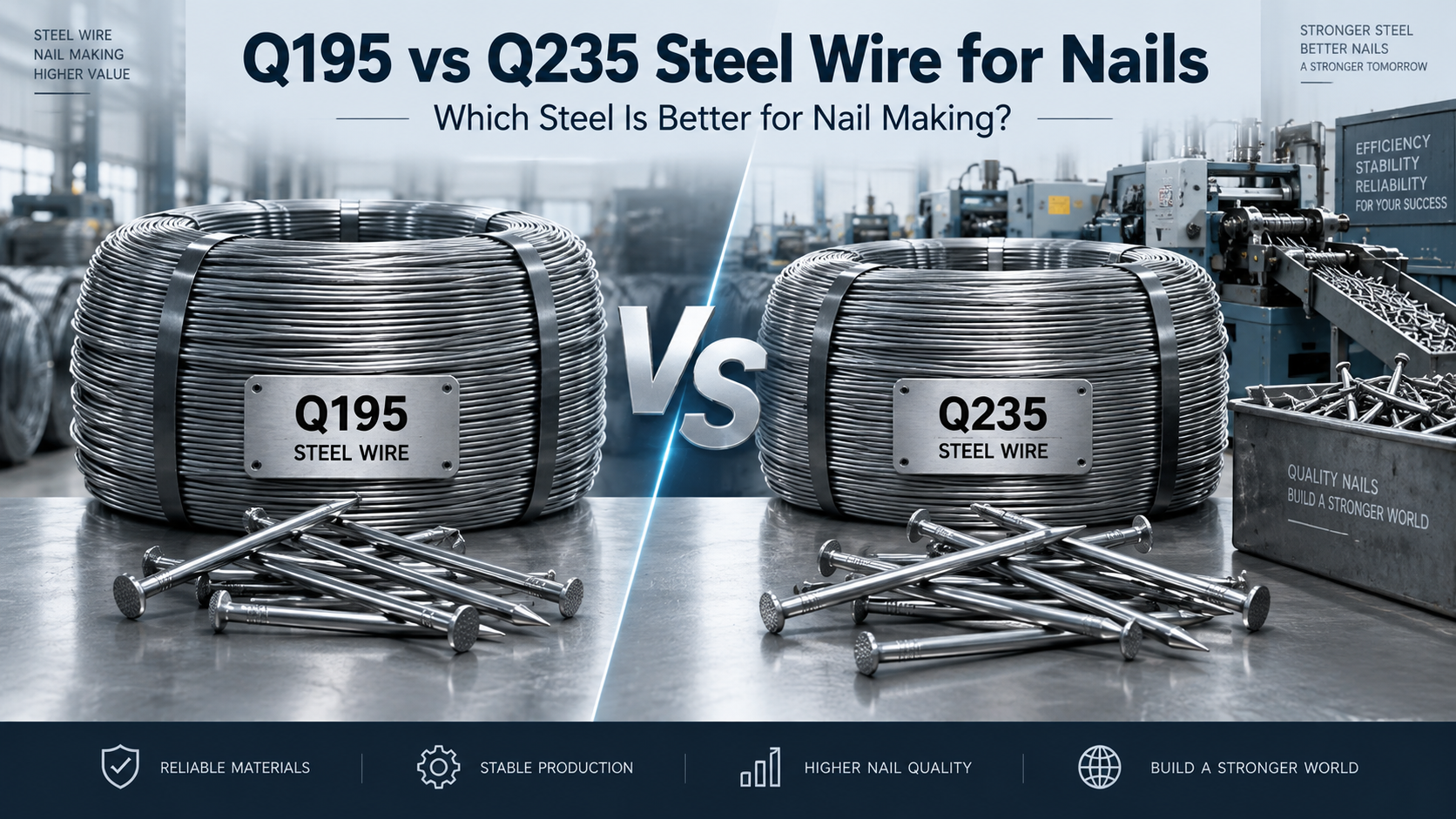 Q195 vs Q235 Steel Wire for Nails: Which Steel Is Better for Nail Making?Choosing the correct steel wire is one of the first technical decisions when establishing a nail manufacturing factory.Many investors ask:Should I use Q195 or Q235 steel wire for nail production?Both grades are commonly discuss


