


Blog Detail

How to Choose a Nail Polishing Machine for Wire Nails: Capacity, Process & Surface Finish
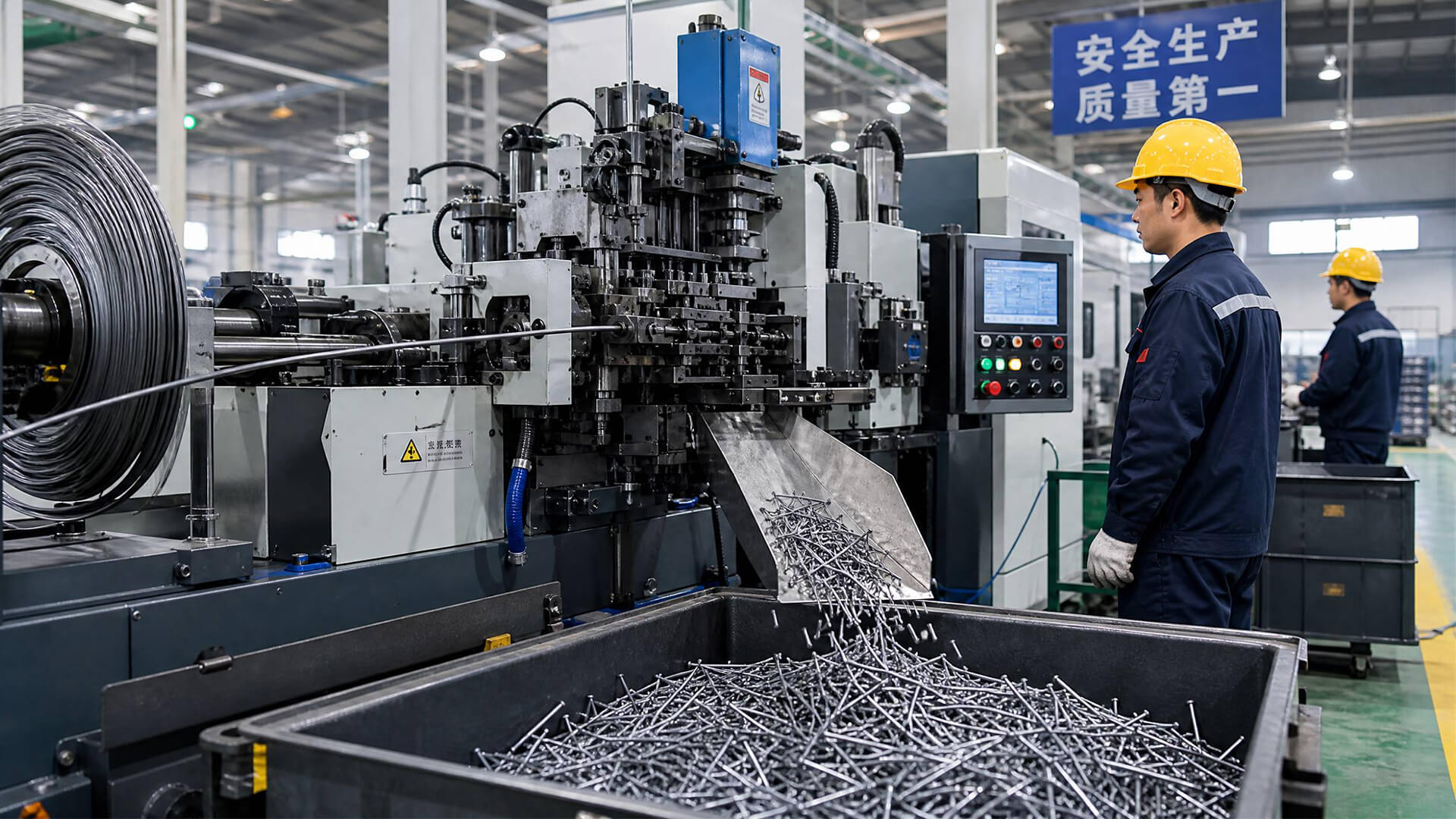
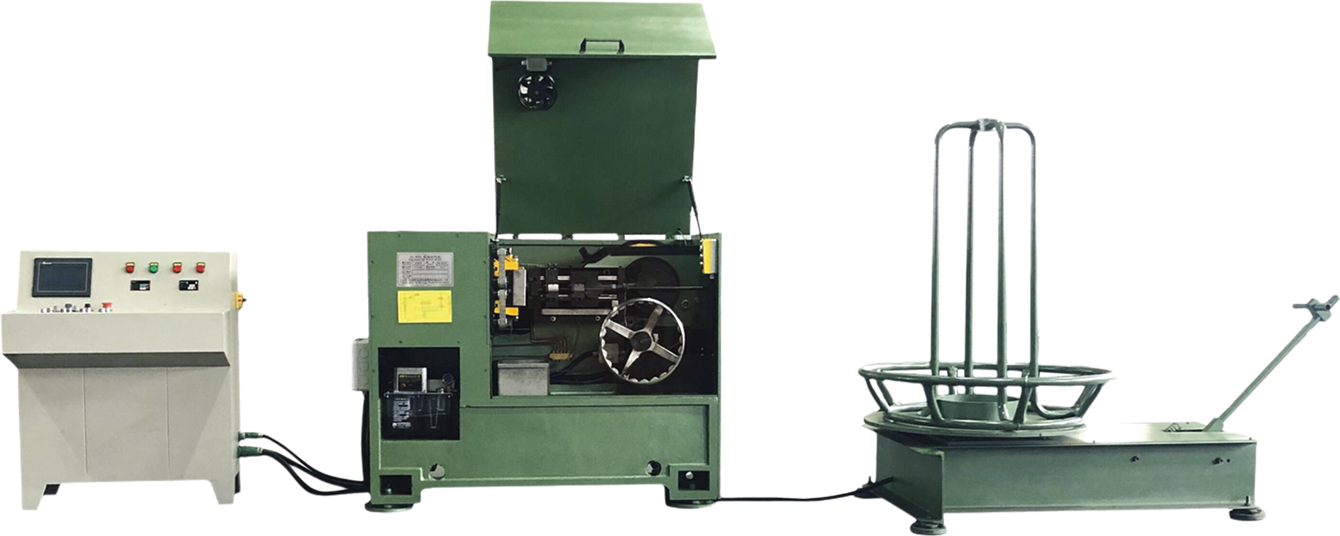
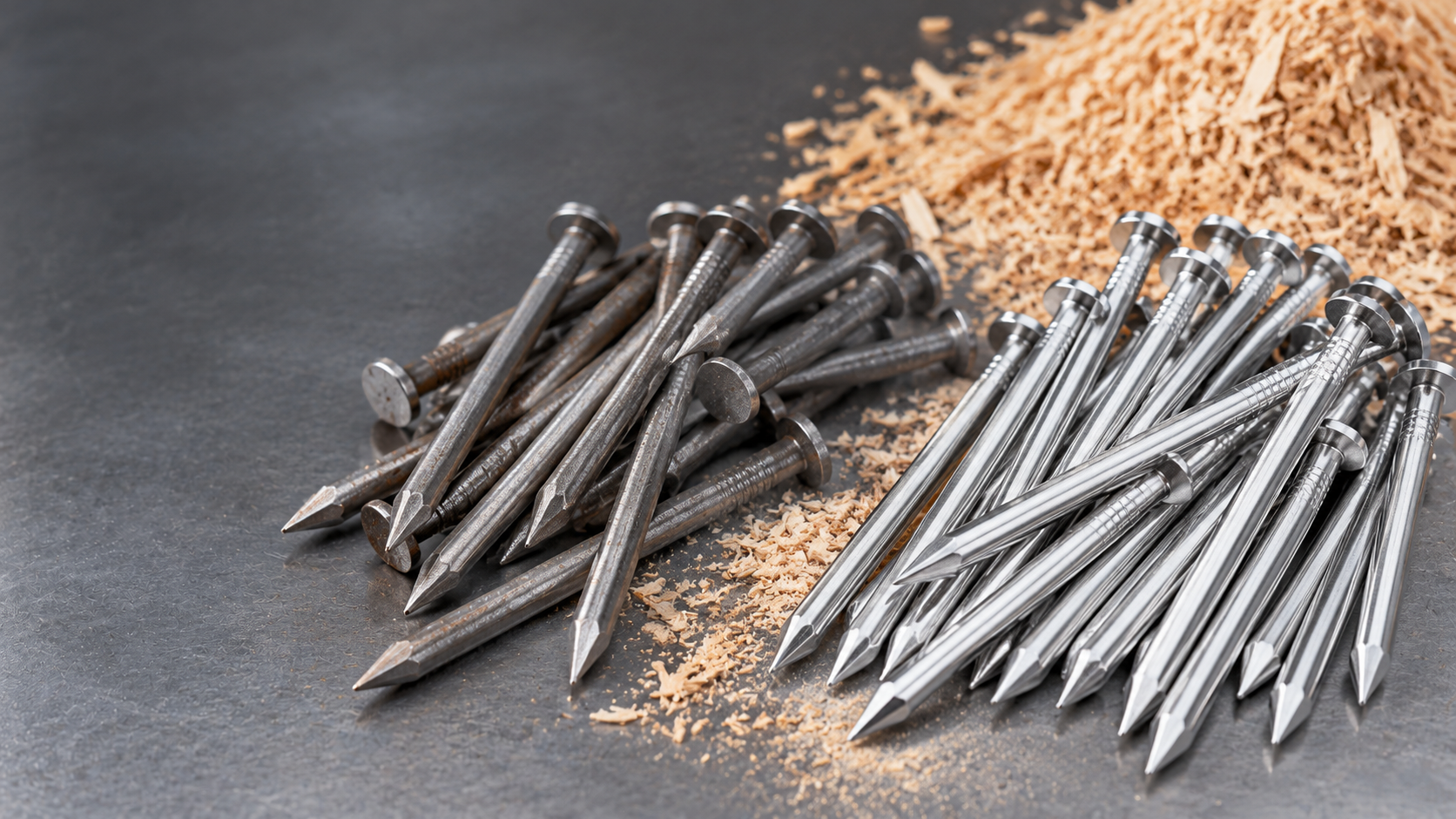
A nail making machine forms the nail, but the production process does not always end when the nail leaves the forming machine. Depending on the required appearance and the next production stage, loose wire nails may need cleaning and polishing to remove burrs, oil, rust residue and surface contamination.
For a nail factory, choosing the right nail polishing machine is not simply a matter of selecting the largest loading capacity. Buyers should also compare the actual polishing cycle, the nail condition, the required surface finish, loading and unloading time, and the output of the upstream nail making section.
This guide explains how a nail polishing machine works, how to evaluate its capacity, and what information to prepare before requesting a quotation.
Quick Answer: How Do You Choose a Nail Polishing Machine?
Choose a nail polishing machine according to five factors:
· The nail types, dimensions and condition entering the polishing process.
· The required finish, such as burr removal, oil cleaning or a brighter surface.
· The verified usable load per batch.
· The complete cycle time, including rough polishing, fine polishing, loading and unloading.
· The hourly output of the nail making section and the buffer available between processes.
Do not treat the machine's stated loading capacity as its hourly production capacity. A batch machine must be evaluated by the amount of acceptable nails it can process over a complete operating cycle.
1. What Does a Nail Polishing Machine Do?
A nail polishing machine is used to process loose nails after nail forming. Its purpose is to improve the surface condition and appearance before the nails are packed or transferred to another production stage.
Depending on the incoming nail condition and the selected process, polishing can help:
· Remove loose burrs and surface residue.
· Reduce oil and dirt remaining on the nails.
· Improve surface brightness.
· Produce a more uniform appearance within a batch.
· Prepare nails for inspection, packing or a suitable downstream process.
Polishing is a finishing operation. It does not replace wire drawing, nail forming, heat treatment, galvanizing or another specified surface coating process. Deep corrosion, incorrect dimensions, bent shanks and serious forming defects should be investigated separately rather than expected to disappear during polishing.
For the upstream forming process, see JINGU's high-speed nail making machines.
2. How Does the Nail Polishing Process Work?
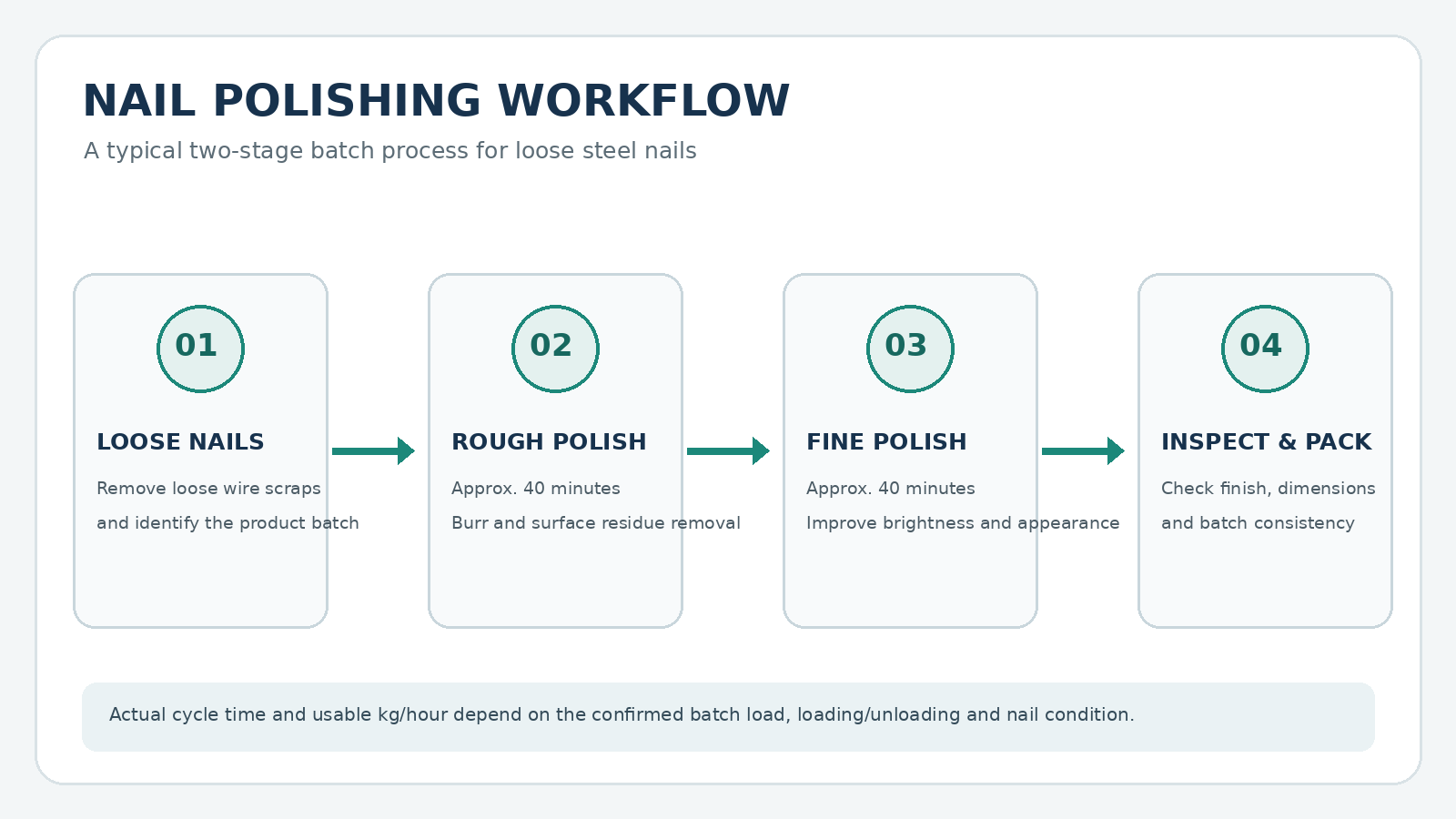
A typical JINGU nail polishing process uses two stages:
1. Rough polishing to remove burrs and surface residue.
2. Fine polishing to improve brightness and the final appearance.
The current JINGU product-page FAQ gives a reference of approximately 40 minutes for rough polishing and another 40 minutes for fine polishing. The time is adjustable and should be confirmed with the actual nail type, loading quantity and finish requirement.
The listed polishing medium is sawdust. The correct loading method and medium condition should be confirmed with the supplier for the customer's nail specifications.
A simplified process is:
Loose nails → Rough polishing → Fine polishing → Inspection → Packing or next process
Why Are Two Stages Useful?
Rough polishing and fine polishing have different purposes. The first stage focuses on removing loose burrs and residue. The second stage focuses on improving the surface appearance.
Trying to shorten the process without checking the final nail sample can lead to inconsistent results. The correct cycle should be established through a trial using the customer's actual nails.
3. Understand Batch Capacity, Cycle Time and kg/Hour
This is one of the most important points when comparing polishing machines.
Three different figures should be kept separate:
· Batch load: the amount of nails loaded for one polishing cycle.
· Cycle time: the time required to complete the process, including both polishing stages and material handling.
· Effective throughput: the amount of acceptable finished nails processed per hour.
A machine with a large batch load does not automatically have a higher hourly output. If its cycle is longer or loading and unloading take more time, its actual throughput may be lower than expected.
Use this formula after the supplier confirms the actual usable batch load and full cycle time:
Effective polishing throughput (kg/hour) = Usable batch load (kg) × 60 ÷ Complete cycle time (minutes)
The complete cycle should include loading, rough polishing, fine polishing, unloading and any necessary handling or inspection time. Do not calculate hourly output from the drum load alone.
For a wider production calculation, see JINGU's nail making machine production capacity guide.
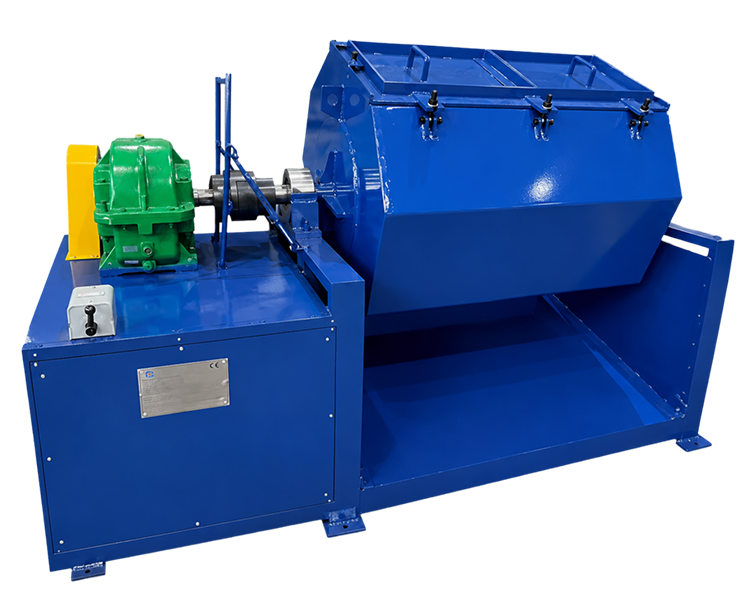
4. JINGU Nail Polishing Machine: Published Technical Information
The current JINGU product page lists the following information:
Parameter | Published information |
Power supply | 380 V / 50 Hz |
Total power | 5.5 kW |
Nail capacity | 800 kg on the technical table |
Bucket weight | 300 kg |
Total machine weight | 1,500 kg |
Overall dimensions | 2,360 × 1,700 × 2,400 mm |
Standard capacity options in FAQ | 800 kg / 1,000 kg / 2,000 kg |
Polishing medium listed | Sawdust |
Rough polishing reference | Approx. 40 minutes, adjustable |
Fine polishing reference | Approx. 40 minutes, adjustable |
The product page's technical table shows 800 kg, while its FAQ lists 800 kg, 1,000 kg and 2,000 kg as standard capacity options. These figures should be confirmed against the exact machine configuration being quoted. They should not be interpreted as kg/hour output.
5. How to Match Polishing Capacity with Nail Making Capacity
The polishing section should be able to process the nails supplied by the nail making section over the planned working schedule.
Before selecting the polishing machine, calculate the expected nail output in kilograms per hour for each priority nail size. Nail making speed in pieces per minute is not enough because different nail diameters and lengths have different unit weights.
The production capacity guide explains the relationship between pieces per minute, nail weight, kg/hour and tons per day.
When comparing the polishing machine with the nail making section, check:
· How many nail making machines will feed the polishing process?
· What is the practical kg/hour output for each priority size?
· Will the factory polish one product in a batch or several products separately?
· Can the polishing machine complete the required batches during the planned shifts?
If the polishing section is slower than the forming section, loose nails will accumulate between processes. If the polishing machine is much larger than the factory's actual requirement, the investment may be underused.
6. How Does Nail Type Affect Polishing?
Do not assume that every nail type should use exactly the same polishing time.
The result may vary with:
· Nail diameter and length.
· Nail head shape and shank design.
· Initial oil, rust or burr condition.
· Surface finish required by the customer.
· Loading quantity and the condition of the polishing medium.
· Whether the nails will be packed loose or transferred to a collating process.
For ring-shank or screw-shank nails, the finishing process must preserve the formed shank profile. For nails that will be collated, the surface condition should also be suitable for stable feeding and the selected joining process.
For example, JINGU's coil nail production line guide explains why cleaning, shank forming and collating sequence should be confirmed according to the actual nail design.
7. What Should You Check After Polishing?
A polishing machine should be evaluated by the quality of the finished nails, not only by how they look immediately after unloading.
A practical inspection checklist includes:
· Surface condition: check whether loose oil, dirt and residue have been removed to the required level.
· Brightness: compare the finished sample with the customer's agreed reference.
· Nail head: check for scratches, impact marks or visible deformation.
· Shank: check that the shank remains straight and the required profile is preserved.
· Point: check that the nail point remains acceptable.
· Dimensions: confirm that polishing has not caused unacceptable damage or loss of the required geometry.
· Batch consistency: compare samples from different parts of the load.
If nails are bent or have incorrect heads before polishing, correct the forming or handling problem first. A polishing machine should not be used to hide defects created upstream.
For machine maintenance and inspection routines, see JINGU's nail making machine maintenance guide.
8. Should You Polish Nails Before Collating?
The correct sequence depends on the nail type, shank design, surface requirement and collating method.
For some products, polishing is used before collating to improve cleanliness and appearance. If ring or screw shank forming is required, the sequence should be tested to ensure that the shank profile is not damaged and the nails still feed and collate correctly.
For plastic strip, paper strip and wire-welded coil nails, the collating process and joining material are different. Review the product and nail-gun requirements before fixing the production route.
See our companion guide: Plastic Strip vs Paper Strip vs Wire-Welded Coil Nails.
9. Common Mistakes When Buying a Nail Polishing Machine
Mistake 1: Comparing only the stated capacity
A batch load is not the same as hourly output. Always ask for the complete cycle time and usable load.
Mistake 2: Ignoring loading and unloading time
Material handling is part of the production cycle. It must be included in the capacity calculation.
Mistake 3: Using one polishing cycle for every nail
Different nail types and incoming surface conditions may need different settings. Confirm the process with a sample.
Mistake 4: Assuming polishing can correct forming defects
Bent nails, incorrect dimensions and badly formed heads require upstream diagnosis.
Mistake 5: Selecting a machine before calculating line balance
The polishing section should match the actual output of the nail making machines and the factory's working schedule.
Mistake 6: Forgetting the downstream process
If nails will be collated, confirm that the finished surface and shank condition are suitable for the selected collator.
10. Information to Send Before Requesting a Quotation
To recommend a suitable nail polishing machine, prepare the following information:
· Nail diameter and length.
· Nail type: common nail, ring-shank nail, screw-shank nail or another type.
· Incoming nail condition: oil, burrs, rust residue or other surface issues.
· Required finished appearance.
· Expected nail production in kg/hour or tons/day.
· Planned working hours and shifts.
· Required batch load or preferred loading method.
· Power supply: voltage, frequency and phase.
· Photos or a sample of the nails before polishing.
If possible, provide both unpolished and target finished nail samples. This helps the supplier evaluate the process rather than selecting a machine from capacity alone.
Frequently Asked Questions
What is a nail polishing machine used for?
It is used to remove burrs and surface residue, reduce oil or rust residue where applicable, and improve the appearance of loose steel nails.
What polishing medium does JINGU list?
The current JINGU nail polishing machine FAQ lists sawdust. Confirm the suitable medium and loading method for the actual nail type.
How long does one nail polishing cycle take?
JINGU lists approximately 40 minutes for rough polishing and another 40 minutes for fine polishing as adjustable references. Actual time depends on the nails, loading quantity and required finish.
Does an 800 kg capacity mean 800 kg per hour?
No. The listed 800 kg is a machine capacity figure, not a confirmed hourly output. Effective kg/hour must be calculated using the verified usable batch load and complete cycle time.
Can a nail polishing machine remove rust?
The JINGU product FAQ states that the machine helps remove rust, oil and burrs. The result depends on the initial condition and process. Heavy corrosion or a required protective coating needs a separate process assessment.
Can polished nails go directly to a collating machine?
That depends on the nail design and collating process. Confirm the required shank condition, cleanliness and feeding behavior using a production sample.
How do I choose between 800 kg, 1,000 kg and 2,000 kg capacity?
Compare the actual usable load, complete cycle time, nail making output, working hours and buffer space. Ask the supplier to confirm the selected configuration and expected usable throughput.
Plan Your Nail Polishing Process with JINGU
The right nail polishing machine should match your nail specifications, surface requirements and production target.
Send JINGU your nail samples, dimensions, required output and working schedule. Our team can review the polishing process and recommend a suitable configuration.
Explore the JINGU Nail Polishing Machine or contact JINGU for a project-specific quotation.
Related Blogs
-
 When choosing a nail making machine, one of the most important questions is:How many nails can the machine produce per hour?However, nail production capacity cannot be judged only by the machine's maximum speed.A complete production calculation should consider:Machine speed in pcs/minNail diameterNa
-
 This guide explains how to start a nail manufacturing business, including nail making machines, wire drawing machines, complete nail production lines, production processes, factory requirements, and cost factors. Learn how to build an efficient nail factory with the right equipment.
-
 How to Choose a Nail Polishing Machine for Wire Nails: Capacity, Process & Surface FinishA nail making machine forms the nail, but the production process does not always end when the nail leaves the forming machine. Depending on the required appearance and the next production stage, loose wire nails


